
Thermal insulation
Polyamide profiles provide a thermal barrier between aluminum sections. The supplied reference includes thermal conductivity and linear expansion values.
Products / 02
Polyamide insulation profiles
PA66 GF25 and custom thermal break profiles are supplied for aluminum window, door and curtain wall systems. Profile matching starts with the cross section and the requirements of the complete system.
We can review profile structures, optimize drawings and develop matching extrusion molds to support finished strip supply or production setup.
Request profile matching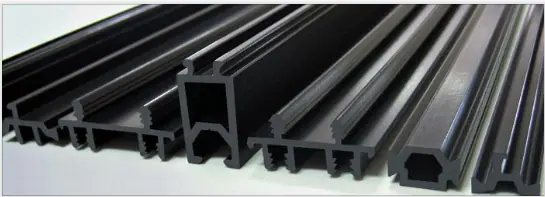
Specifications
The following table reproduces the supplied thermal break strip requirements for technical discussion and profile selection.
| Item | Profile / condition | Requirement |
|---|---|---|
| Density | — | (1.30±0.05) g/cm³ |
| DSC melting peak temperature | — | ≥255℃ |
| Axial stress cracking performance | — | No cracks at hole opening |
| Shore hardness (H₀) | — | 20±5 |
| Low-temperature unnotched impact strength (-30℃ ±2℃) | — | ≥50kJ/m² |
| Room-temperature longitudinal tensile characteristic value (23℃ ±2℃) | — | ≥90MPa |
| Room-temperature longitudinal tensile fracture elongation | — | ≥3% |
| Room-temperature longitudinal tensile modulus | — | ≥4500MPa |
| Room-temperature transverse tensile characteristic value (29℃ ±2℃) | Type I (profile height <20mm) | ≥90MPa |
| Room-temperature transverse tensile characteristic value (29℃ ±2℃) | Type I (profile height ≥20mm) | ≥80MPa |
| Room-temperature transverse tensile characteristic value (29℃ ±2℃) | Non-Type I * | ≥25MPa |
| High-temperature transverse tensile characteristic value (90℃ ±2℃) | Type I (profile height <20mm) | ≥55MPa |
| High-temperature transverse tensile characteristic value (90℃ ±2℃) | Type I (profile height ≥20mm) | ≥45MPa |
| High-temperature transverse tensile characteristic value (90℃ ±2℃) | Non-Type I * | ≥20MPa |
| Low-temperature transverse tensile characteristic value (-30℃ ±2℃) | Type I (profile height <20mm) | ≥90MPa |
| Low-temperature transverse tensile characteristic value (-30℃ ±2℃) | Type I (profile height ≥20mm) | ≥80MPa |
| Low-temperature transverse tensile characteristic value (-30℃ ±2℃) | Non-Type I * | ≥25MPa |
| Water resistance performance | Type I (profile height<20mm) | Transverse tensile characteristic value ≥35MPa |
| Water resistance performance | Type I (profile height ≥20mm) | Transverse tensile characteristic value ≥75MPa |
| Water resistance performance | Non-Type I * | Transverse tensile characteristic value ≥22MPa |
| Thermal aging performance | Type I (profile height <20mm) | Transverse tensile characteristic value ≥60MPa |
| Thermal aging performance | Type I (profile height ≥20mm) | Transverse tensile characteristic value ≥55MPa |
| Thermal aging performance | Non-Type I * | Transverse tensile characteristic value ≥20MPa |
| Typical thermal conductivity | By hot-flow meter method | 0.30W/(m·K) |
| Coefficient of linear thermal expansion | — | 2.3×10⁻⁵K⁻¹~3.5×10⁻⁵K⁻¹ |
* For non-Type I polyamide profiles, engineering design verification shall be carried out before application.
Values are reproduced from the supplied reference. Confirm the applicable specification and the technical data for your selected profile with our team.
View supplied reference imageMaterial property
Review the material and profile together against the intended application.
Polyamide profiles provide a thermal barrier between aluminum sections. The supplied reference includes thermal conductivity and linear expansion values.
Longitudinal and transverse tensile properties are considered alongside profile geometry and the relevant operating temperatures.
Water resistance and thermal aging requirements form part of the supplied reference for the selected profile type.
Application scenarios
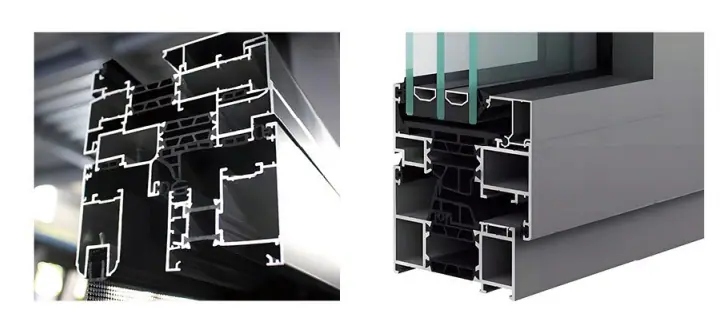
Thermal break strips are matched to aluminum window and door profile structures, with attention to the required fit and overall system performance.
Polyamide insulation profiles can be developed around curtain wall cross sections and the thermal barrier requirements of the facade system.
Drawing optimization, matching tooling and production support help translate a profile requirement into finished strip supply or local manufacturing.